
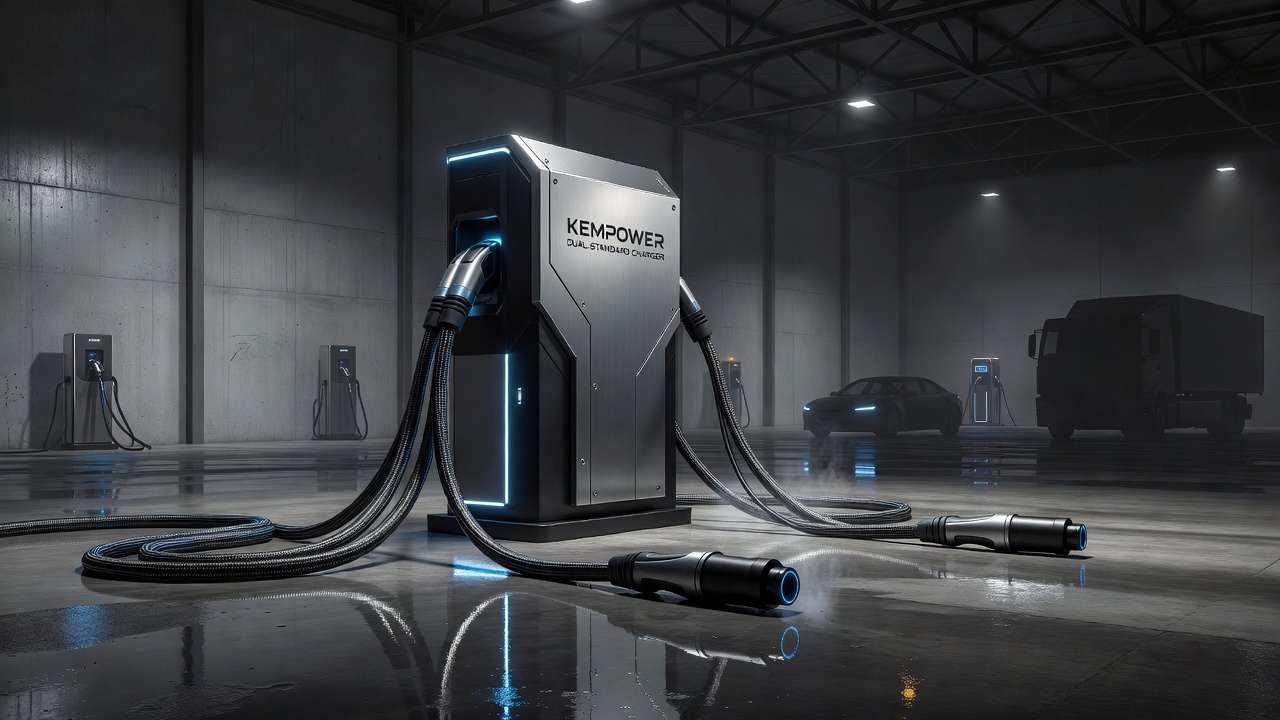
Kempower has introduced a single charging unit capable of serving both passenger EVs and heavy-duty trucks, a design choice that could reshape how charging sites are planned as electric freight moves from pilot programs to routine operation. The new Mega Satellite Flex supports the established Combined Charging System (CCS) at up to 560 kW alongside the emerging Megawatt Charging System (MCS) at up to 1.2 MW, making it the Finnish company's first dispenser built to handle either standard from a single cabinet.
The announcement arrived this week at ACT Expo, during Kempower's Unplug & Recharge event for customers and partners. The timing is deliberate: ACT Expo draws fleet operators, charging network builders, and truck manufacturers who are actively deciding how to allocate capital between today's CCS infrastructure and tomorrow's megawatt corridors. For operators weighing that decision, questions about equipment costs and vendor commitments matter as much as raw power figures - much the way consumers evaluating a subscription service want clarity on how refunds usually work before committing. Kempower's pitch is that a dual-standard unit removes some of that uncertainty by letting one installation serve two vehicle classes without a second capital cycle.
Why Two Standards Still Coexist
CCS has been the dominant fast-charging interface for passenger cars in North America and Europe for years, built around power levels that suit sedans, crossovers, and light vans. Heavy trucks are a different problem entirely. A loaded semi needs to replenish a much larger battery in a limited rest period, which is why the industry developed MCS, a connector and protocol designed for charging rates measured in megawatts rather than kilowatts. The two systems are not interchangeable, and until now, most charging hardware has been built to serve one or the other. That has forced site owners to choose, or to install separate equipment for cars and trucks, doubling permitting, wiring, and grid-connection work.
What the Hardware Actually Delivers
The Mega Satellite Flex is rated for up to 1,500 amps on the MCS side and 700 amps for CCS, with cable lengths of 5 meters for CCS and 2.7 meters for MCS - long enough to reach cab-mounted inlets on trucks without forcing awkward parking maneuvers. An optional payment terminal allows the unit to serve public, pay-per-use locations rather than only fleet depots. Because it connects into Kempower's existing distributed charging architecture, operators who already run Kempower systems can add the new dispenser without redesigning their power cabinets or site layout.
Utilization as the Real Selling Point
The more consequential detail may be the 800-volt compatibility, which lets newer high-voltage passenger EVs draw faster charging speeds from the same hardware serving trucks. For site owners, that flexibility translates directly into utilization: a charger that can serve whichever vehicle pulls in, car or truck, spends less time idle. Given how heavily the economics of public charging depend on keeping dispensers busy, that flexibility could matter more to return on investment than the peak power figures suggest. Kempower says the Mega Satellite Flex is expected to reach North American and European markets in July 2026, giving operators a window to plan sites around a standard still being finalized across the truck-charging industry.